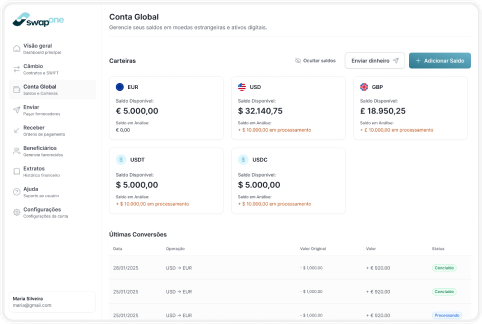
Having a bank account outside Brazil is no longer a privilege reserved for multinationals. Today, small and mid-sized companies that work with international clients, suppliers, or platforms have concrete reasons to consider this structure—and the process, while bureaucratic, is more accessible than it seems.
When it makes sense to have an account abroad
Not every company needs one. However, there are situations in which an international account stops being a convenience and becomes an operational necessity:
- You receive payments from foreign clients and want to avoid forced conversion to Brazilian reais with every incoming payment.
- You regularly pay suppliers in foreign currency and want to reduce FX costs and streamline processes.
- Your company operates on international marketplaces (Amazon, Shopify, Etsy) and needs a local account to receive funds.
- You have a holding structure or subsidiary outside Brazil and need an account to move funds for the operation.
What are the most accessible options
The market has evolved significantly in recent years. Today, the main alternatives are:
- International fintechs such as Wise, Payoneer, and Mercury: remote, fast account opening, with no need for physical presence. Ideal for those who need a functional account with low operating costs.
- Traditional banks in the U.S. or Europe: A more robust process that requires local documentation and, at times, physical presence or a correspondent bank. More suitable for companies with a legal structure abroad.
- Banks in jurisdictions such as Cayman, BVI, or the UAE: Used for holding structures or international wealth planning. They require specialized advisory support.
What Brazil requires from you
Having an account abroad is legal for Brazilians and Brazilian companies—provided that regulatory obligations are met:
- CBE (Declaration of Brazilian Capital Abroad): Mandatory for those with assets abroad above USD 1 million (annual) or USD 100,000 (quarterly). Filed with the Central Bank.
- Income Tax return: Balances in foreign accounts must be reported to the Brazilian Federal Revenue Service, even if there is no income.
- Remittances and inflows: Any movement between an account in Brazil and an account abroad must comply with the Central Bank’s FX regulations.
Ignoring these obligations is not an option: penalties are significant, and the risk of audit increases with the volume of transactions.
The mistake we see most often
Companies open an account abroad in an improvised way—often on their own, following online tutorials—and only discover the regulatory obligations months later, when they already have accumulated, unreported transactions.
Doing it properly from the start is simpler and far less expensive than regularizing it later.
At Swap One, we guide companies throughout this journey: from choosing the best account structure to meeting obligations with the Central Bank and the Brazilian Federal Revenue Service.
Considering opening an account abroad? Let us talk before you open any account.